/
video projection
/
2010
/
THE WORLD IS TOO MUCH WITH US II
/ / /
/
Project infos
video projection, 6min in loop /
The world is too much with us; late and soon,
Getting and spending, we lay waste our powers;
Little we see in Nature that is ours;
We have given our hearts away, a sordid boon!
William Wordsworth (1807)
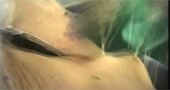
This post-Romantic video focuses on the conspicuous clash and the likely match between the world of man and the world of nature.
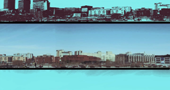
As the opening black screen recedes, an elongated form fades in. After a few fleeting seconds we discern a high-rise building, or rather a somewhat weird, wafer-like ‘collage’ of several buildings. Then the camera lures the eye on a dizzying journey up to the structure’s towering height. Before we have even asked ourselves where we are headed, and before the ‘journey’ has come to an end, the ascent is abruptly interrupted by a horizontal black frame, which cuts right into the middle of the screen. Whilst this switch to the horizontal plane does relieve the vertigo of the vertical, it also adds to the viewer’s unease, because the clarity of form is displaced for a moment by the nothingness of the black color.
The moment of relative comfort does not take long to come. Right at the centre of the screen, from left to right, a serene suburban landscape rushes in. This image, albeit rapidly moving out of sight, gives us a sense of returning to the world as we know it.
We are in for another riddle, though. As two more bands of moving images appear on top and at the foot of the screen, our minds are compelled to interpret again. Why do these images decline to stop for us to have a good look at them? Are the images coming in or going out? What is their origin and what is their destination? Why does the same element show up in a different band before it fades out? How important is color to making sense of it all? Why does color have to wear off to a ghostly black and white? Are these images arranged in a particular pattern? Why is it that that urban and natural landscapes alternate without, apparently, much coherence?
As our minds race to figure out a meaningful interpretation, we might end up thinking that the repetition of some déjà vu images, as well as the re-emergence of natural landscapes amongst the urban frames, should mean that a marriage between man and nature is still possible. This interpretation could be reinforced by the auditory background, which features a well balanced fusion of silence, bird chirps, frog calls, pattering raindrops, the soothing splash of ocean waves, the roar of car engines, the low-pitch whistle of a boat, and the piercing whine of ambulance sirens.
We could be lulled into a false sense of intellectual security if it weren’t for the return of the wafer-like structure at the end of the clip. This time the eye frantically plummets down to the emptiness of the closing frame. Is this the black hole of a world that is too much with us?
Lubomir Terziev
/
Related works
-
2015 The mind is its own place lol
The mind is its own place
-
2014 We the poor of this world... lol
We the poor of this world...
-
2014 Light on Ehge lol
Light on Ehge
-
2013 Nothing Full of Nothing lol
Nothing Full of Nothing
-
2012 Nu descendant un Escalier Nu descendant un Escalier ( iMarcel dimension 4S ), sound installation, 2012 lol
Nu descendant un Escalier
-
2010 THE WORLD IS - II video projection, 6min in loop /
The world is too much with us; late and soon,
Getting and spending, we lay waste our powers;
Little we see in Nature that is ours;
We have given our hearts away, a sordid boon!
William Wordsworth (1807)
This post-Romantic video focuses on the conspicuous clash and the likely match between the world of man and the world of nature. As the opening black screen recedes, an elongated form fades in. After a few fleeting seconds we discern a high-rise building, or rather a somewhat weird, wafer-like ‘collage’ of several buildings. Then the camera lures the eye on a dizzying journey up to the structure’s towering height. Before we have even asked ourselves where we are headed, and before the ‘journey’ has come to an end, the ascent is abruptly interrupted by a horizontal black frame, which cuts right into the middle of the screen. Whilst this switch to the horizontal plane does relieve the vertigo of the vertical, it also adds to the viewer’s unease, because the clarity of form is displaced for a moment by the nothingness of the black color. The moment of relative comfort does not take long to come. Right at the centre of the screen, from left to right, a serene suburban landscape rushes in. This image, albeit rapidly moving out of sight, gives us a sense of returning to the world as we know it. We are in for another riddle, though. As two more bands of moving images appear on top and at the foot of the screen, our minds are compelled to interpret again. Why do these images decline to stop for us to have a good look at them? Are the images coming in or going out? What is their origin and what is their destination? Why does the same element show up in a different band before it fades out? How important is color to making sense of it all? Why does color have to wear off to a ghostly black and white? Are these images arranged in a particular pattern? Why is it that that urban and natural landscapes alternate without, apparently, much coherence? As our minds race to figure out a meaningful interpretation, we might end up thinking that the repetition of some déjà vu images, as well as the re-emergence of natural landscapes amongst the urban frames, should mean that a marriage between man and nature is still possible. This interpretation could be reinforced by the auditory background, which features a well balanced fusion of silence, bird chirps, frog calls, pattering raindrops, the soothing splash of ocean waves, the roar of car engines, the low-pitch whistle of a boat, and the piercing whine of ambulance sirens. We could be lulled into a false sense of intellectual security if it weren’t for the return of the wafer-like structure at the end of the clip. This time the eye frantically plummets down to the emptiness of the closing frame. Is this the black hole of a world that is too much with us?
Lubomir Terziev lolTHE WORLD IS - II
-
2009 THE WORLD IS - I video projection, 6min
The world is too much with us; late and soon,
Getting and spending, we lay waste our powers;
Little we see in Nature that is ours;/We have given our hearts away, a sordid boon!
William Wordsworth (1807)
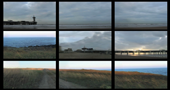
This post-Romantic video focuses on the conspicuous clash and the likely match between the world of man and the world of nature. The mosaic of moving images leaves the beholder with an ambivalent sense of discontinuity and flow. Each image is confined to its own frame and yet the frames gradually reveal themselves as the fragments of a series of pictures.
As the frames tail off to the top left end of the screen and are succeeded by new frames streaming into the bottom right corner, we realize that the human presence in these landscapes is slowly but steadily growing: the clear horizon, the green fields and the blue sea of the opening frames give way to a skyline of high-rise buildings and skyscrapers, which are in turn replaced by the recesses of industrial backyards. The movement from right to left suggests regress rather then progress.
At the same time, the repetition of some déjà vu images, as well as the re-emergence of natural landscapes amongst the urban frames, makes one think that the process is not necessarily irreversible and that a marriage between man and nature is still possible. The musical score, which features a blend between the variations of natural chirps and the repetitiveness of an electronic beat, contributes to conveying the same message.
Lubomir Terziev lolTHE WORLD IS - I
-
2008 Sometimes Closed lol
Sometimes Closed
-
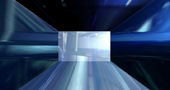
2007 MIGRATION ADDICT video, 06 min / In this video, the screen is divided into five sub-spaces: one central rectangle and four lateral triangles. The central sub-screen features shots taken in the engine room of a ship. Fragments from these images spill over into the lateral screens and fail to take shape. The fluidity of form in the margins shakes the mimetic stability of the centre. The centre itself is far from solid as it “feeds” the margins with fragments. Thus a familiar piece of technology is defamiliarized. The dynamic musical score adds to the psychedelic effect. lol
MIGRATION ADDICT
-
2006 6mins 59sec 24f Green electronic digits fill the blank screen, changing from 00mins 00sec 00f to 6mins59sec24f, (7mins). Against the background of this tiny image, our ear is focused on a vast variety of sounds, which are as routinely urban as they are surrealistic. Listening, we end up witnessing a journey and a life with all its ups and downs, squeezed into the confines of 7 min. lol
6mins 59sec 24f

-
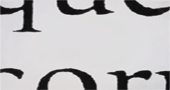
2002 Between the Lines Video - 4,41min / The phrase “Read between the lines” exists in all languages and it has the same interpretation in any of them. A macro shot, while entering and moving in the empty space between lines taken from newspapers written in French, English and Bulgarian. The viewer can only see small parts of the letters situated at the top and bottom of the screen. The image is graphically simplified to the point of the pure symbol. The movement within this empty space found between the lines is subtly emphasized by Dan Senn’s music. lol
Between the Lines
-
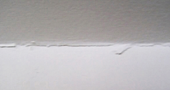
2001 In - Between – Out 2001, video, 11.22min / Using the language of minimalism, the author follows with a close up the movement of the line that separates two orthogonal surfaces - the wall and ceiling. The camera enters the front door and sequentially examines all corners, then subsequently exists, again through the front door. The image is abstract, freeing the imagination of the viewer. The rhythmic appearance of a second wall, or a three-point corner, momentarily pulls he viewer back away from the abstract world, preparing him for another dream. The music, which is an important part of the work was created by New York based minimalist Phill Niblock. lol
In - Between – Out
-
2000 OPEN-CLOSED lol
OPEN-CLOSED